
News
The Burghers of Calais | A Story of Courage and Devotion
 Anne · 3 min read
Six essential figures from Calais. Six silhouettes forever immortalised by the famous sculptor Auguste Rodin. Six men who joined their fate together to save the port city. A closer look at The Burghers of Calais, a world-famous work of art, standing at the foot of the Calais belfry, which hands down through time an emblematic tale of courage, sacrifice and devotion to this town.
The Burghers of Calais: the historical background
Let's go back in time to the fourteenth century. The Hundred Years' War, fought from 1337 to 1453, pitted England against France in a fierce struggle for supremacy in Europe. Two kings were then vying for the French crown: the French sovereign Philip VI of Valois and the English king Edward III. Northern France suffered particularly badly from this war. The English monarch, victorious in numerous battles, wanted to extend his power and his army as far as the strategically important town of Calais. He had the advantage of ruling the sea, which would lead to a complete break in supplies and cause famine and a desperate situation for all the town's inhabitants. They showed heroic tenacity, courage and resistance. Starving, exhausted and sick, the people of Calais accepted surrender on 3 August 1347, after a siege that had lasted 11 weeks. Edward III spared their lives and allowed them to leave the town so the English could settle there, on condition that 6 notables came forward to be executed. Faced with this critical situation, the mayor of Calais, Eustache de Saint-Pierre, and five other prominent townsmen showed extraordinary courage and volunteered:
- Jean d'Aire;
- Pierre de Wissant;
- Jacques de Wissant;
- Andrieus d'Andres;
- Jacques de Fiennes.
Dressed in simple penitents' robes, they left the town walls and gave themselves up to the enemy lines, ready to be executed to appease the anger of the English king, Edward III. The king, moved by their devotion, would ultimately spare their lives at the request of his wife, Queen Philippa.
Auguste Rodin and the Burghers of Calais
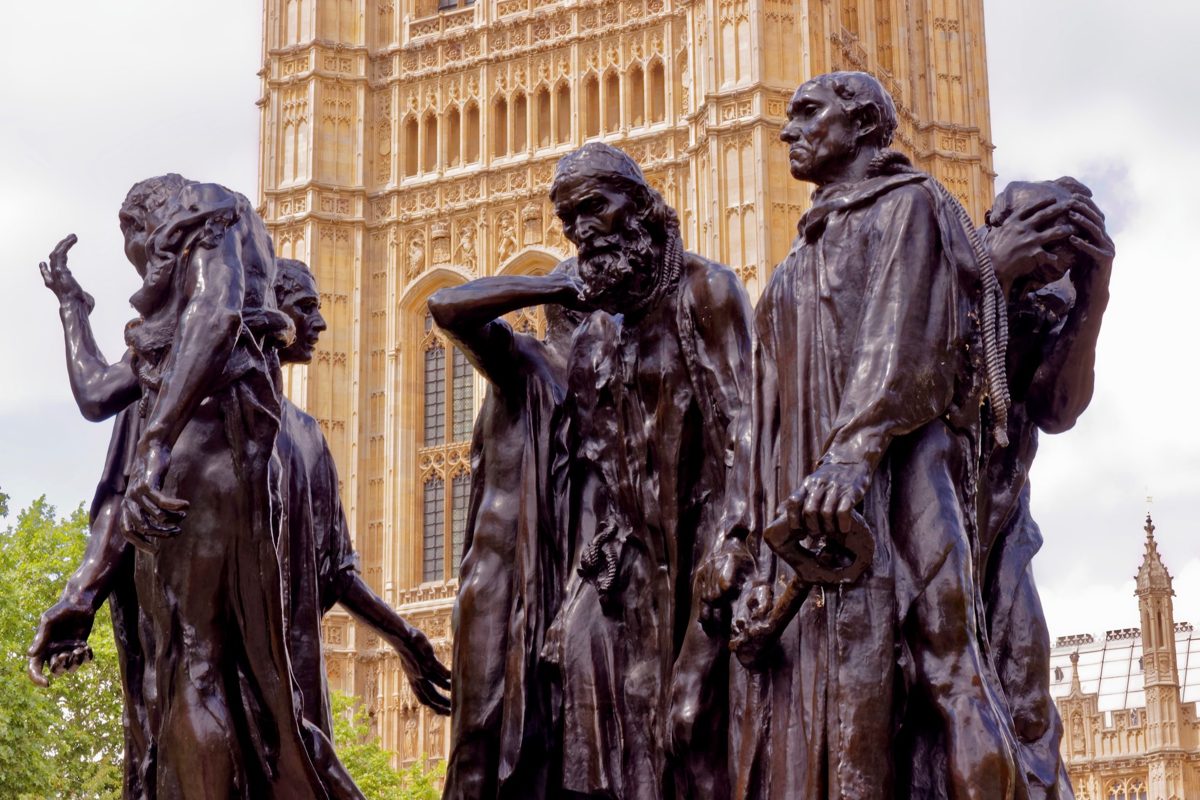
The story of the burghers of Calais has become a powerful symbol of courage and determination. It was immortalised by Auguste Rodin (1840-1917) in his famous bronze sculpture The Monument to the Burghers of Calais. Commissioned from the sculptor in 1884 by Omer Dewavrin, mayor of Calais, the work was completed in 1889. It was installed in 1895 on the square in front of Calais town hall.
This iconic work of art shows the six heroes in a pose that expresses their resolve in the face of adversity. Six independent silhouettes, yet united towards a tragic end, on a single base that seals their ultimate sacrifice.
Rodin, an immense sculptor and heir to realism and humanism, conveys in this work all the strength, courage and self-sacrifice of these devoted martyrs. Draped in a simple tunic, barefoot, rope around their necks, the 6 notables were sculpted with such precision that their features, frozen for eternity, give the impression that their sacrifice is current and that the figures are almost in motion.
The legacy of the Burghers of Calais
This episode from the Hundred Years' War has been immortalised forever by this sculpture, which has since been reproduced in 12 casts. Exhibited in various museums around the world, the Monument to the Burghers of Calais and its legacy are not limited to art. The story of these six men, who risked their lives to rescue the besieged town, reminds people that, even in the darkest moments, extraordinary acts of courage and devotion can arise. It invites us to reflect on what we would be prepared to do to save what we hold most dear, whether that's a town, a cause or loved ones. This monument, one of the most photographed in the town, remains a poignant testament to courage and sacrifice.
Read next

A word on this article?
No reviews yet. Yours will be the first.
The form is unavailable at the moment. Send your review to the editors, we’ll publish it here.